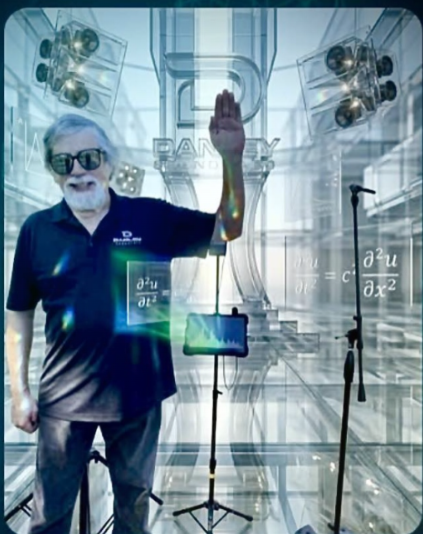
Craftsman of Physics
Tom Danley is not a conventional loudspeaker designer; he is a craftsman of acoustical physics. An American inventor, co-founder of Danley Sound Labs and former NASA contractor, his entire career rests on one unbreakable premise: "The physics doesn't care about your opinion; it just works." His pragmatic, measurement-driven approach has repeatedly overturned rigid academic assumptions and redefined how we experience sound at large scale.
"The physics doesn't care about your opinion. It just works."
Conquering Zero Gravity (1979 - 1980s)
Before he reshaped the world's stadiums, Danley worked with his eyes on the cosmos. As a lead engineer at Intersonics Corporation, he worked with NASA on acoustic levitation in microgravity, designing payload hardware flown on Space Shuttle missions STS-7 (1983) and STS-51-A (1984). That work produced the bulk of his early patents — including the acoustic levitator and a sonic-boom generator — and taught him to treat acoustics not as a passive listening phenomenon but as a raw physical force capable of moving matter.
ServoDrive: Bass Without Compromise
Back on Earth, Danley turned that mindset on the historic enemy of concert-scale low frequency: thermal compression in conventional voice coils. His answer was the ServoDrive subwoofer, replacing the voice coil with a high-speed servomotor belt-driving the diaphragms. The BassTech 7 went out on Michael Jackson's Thriller and U2's Unforgettable Fire tours, roughly 500 units went to Disney, and the technology anchored Las Vegas rooms including the Mirage and Treasure Island. Along the way he built the Pachyderm 6 (1986) for Cornell's research into elephant infrasonic vocalization, and the Contrabass (1987) for home theater — one of which went to George Lucas.
Sound Physics Labs and the Birth of Unity (late 1990s - 2003)
Partnering with Bradford Skuran at Sound Physics Labs, Danley developed the multiple-entry horn: several drivers of different bandwidths summing coherently inside a single horn. The seven-driver SPL-td1 (2000) proved it in the field at the 2002 Salt Lake City Winter Olympics ceremonies. The "Unity" horn was patented in 2002 and licensed to Yorkville Sound in 2003. In parallel, his open-sourced LAB subwoofer design (2002), built around the Eminence LAB12 driver, became one of the most-built DIY horn projects in pro audio history.
Danley Sound Labs: 2005 to Today
In 2005, Danley co-founded Danley Sound Labs in Gainesville, Georgia, with entrepreneur Mike Hedden. For the first time he owned the whole chain — patent, prototype, production and installation — and the company became the vehicle for ideas he had been refining for thirty years. The first product was the modest SH100, an 8-inch coaxial box aimed at churches; months later came the SH50, a three-way, seven-driver point source combining Synergy Horn and Tapped Horn technology to reach 50 Hz from a single coherent 50° × 50° wavefront. That one box set the template for everything that followed.
The Synergy Horn lets low, mid and high drivers share one acoustic throat and one apparent origin, radiating a single phase-coherent wavefront instead of the stacked, interfering sources of a conventional multi-way box. The Tapped Horn folds the driver's rear output back into the mouth so front and rear radiation add in phase, extracting far more low end from a given cabinet volume. Together they are Danley's central argument: intelligent acoustic geometry beats digital correction applied after the fact.
Milestones at Danley Sound Labs
- 2005 Company founded in Gainesville, GA with Mike Hedden. SH100 ships, followed by the landmark SH50.
- 2007 The Matterhorn — forty 15-inch drivers in a shipping container, widely called the world's biggest subwoofer.
- 2009 Shaded Amplitude Lens patented: internal vanes shape coverage for very large venues.
- 2010 The Jericho Horn — four-way, 16 drivers — brings stadium-scale point-source coverage from a single hang position.
- 2011 Paraline patent filed: multiple HF drivers summed through parallel partitions.
- 2017 Four Jericho Horns and 22 TH-118 subwoofers power the Temple stage at Glastonbury Festival.
- 2019 Tom Danley receives the Adele De Berri Pioneers of AV Award from AVIXA at InfoComm.
- 2020s Stadium-wide point-source systems: J8-94 arrays for NC State's 56,919-seat football home in Raleigh, and J8-94 / SH62 / SH46 for a 30,000-capacity soccer stadium in Comarca Lagunera, Mexico. Danley technology also moves into cinema.
- 2024 Danley joins the Russ Berger Design Group redesign of Crossway Studio, Whitney Houston's former private studio.
- 2025 Twenty years in business. Provisional patent for Cohearix Lens technology, with the first loudspeaker built on it and a whole new family in development; the Wireless Link System (10 Hz – 24 kHz, uncompressed point-to-point) and a weatherized outdoor amplifier round out the year.
Two decades in, the pattern holds: Danley still designs by measurement and first principles, still treats the loudspeaker as an acoustical machine rather than a DSP problem, and still serves as the technical center of the company that carries his name.
Family Legacy and Modeling the Future
Tom Danley's impact goes beyond the patents; it lives in the people who continue and refine his vision. At the center of his life are his daughters, Clare and Ali Danley.
It is in his daughter Ali Danley that the technical legacy finds a direct bridge to the future. With extraordinary command of computer-aided design, Ali has become a key and highly respected member of the engineering modeling team. Her exceptional ability to translate Tom's complex acoustical physics into ultra-precise virtual models brings to life projects that push past the limits of conventional design — the perfect symbiosis of an inventor's intuition and modern engineering's digital mastery.